
AI Can Plan a 5-Day Kerala Trip in 30 Seconds. So Why Do Travel Agents Still Win the Booking?
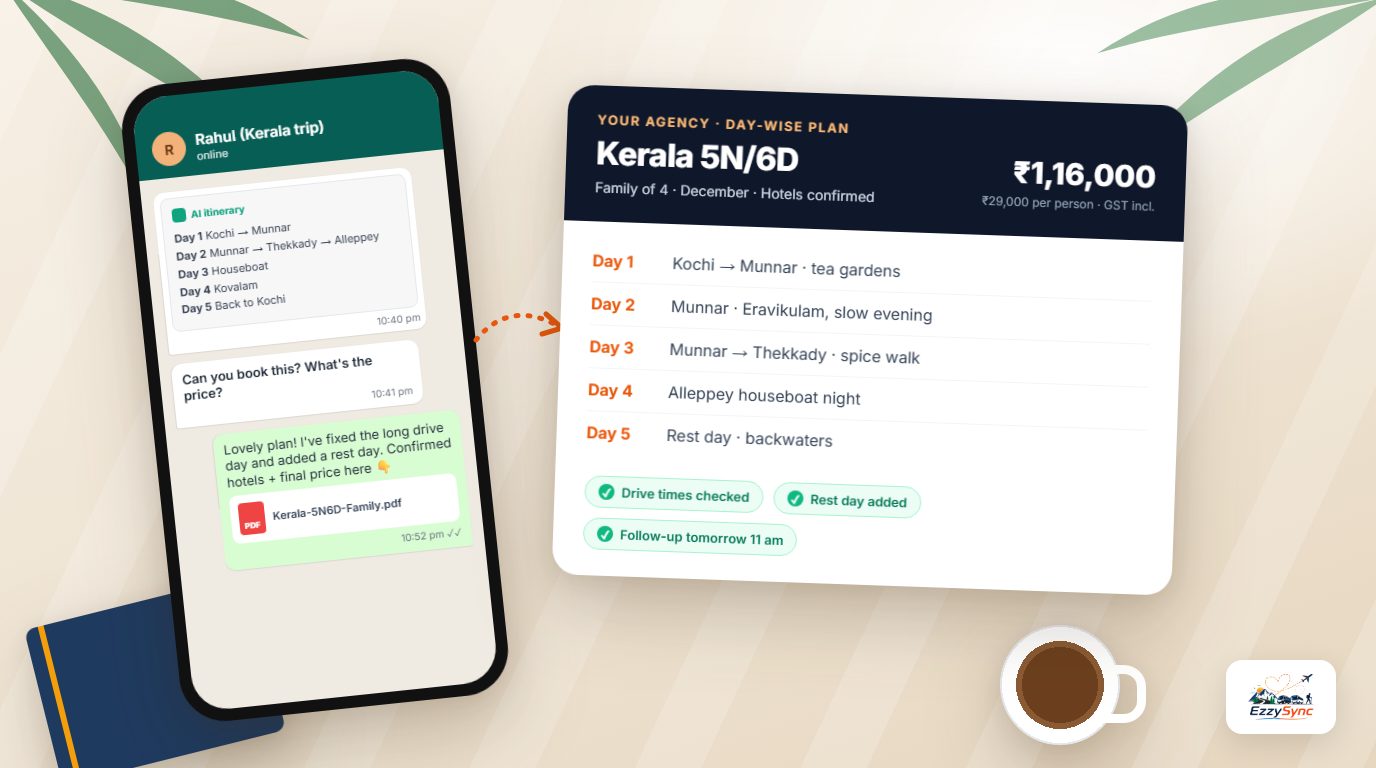
A client messages you on WhatsApp at 10:40 pm. Attached is a screenshot: a neat, day-by-day Kerala itinerary that ChatGPT made for them in half a minute. Munnar, Thekkady, a houseboat in Alleppey, back to Kochi. Their question is short:
"Can you book this? What's the price?"
This is now a normal Tuesday for Indian travel agents. Travellers arrive with AI-made plans, and many agents use the same tools to draft their own. So it's fair to ask: if a machine can plan a trip in 30 seconds, what exactly is the agent being paid for?
The answer is the reason good agencies are doing fine. AI is very good at the first 60 seconds of trip planning. It's surprisingly bad at the parts that decide whether the trip actually works — and whether the client books with you.
What AI itineraries are genuinely good at
Let's be fair to the tools first. For a travel agency, an AI assistant is useful for:
A fast first structure. "5 days, Kerala, family with two kids, not too much driving" gives you a sensible skeleton in seconds. That used to take a senior agent ten minutes of typing.
Descriptions clients enjoy reading. A two-line, warm description of Eravikulam National Park or a Mandovi sunset cruise is exactly the kind of text agents used to copy from old Word files.
Variations on demand. "Make it a honeymoon version." "Swap Thekkady for Kumarakom." "Add a rest day." AI makes revisions cheap, and clients love revisions.
Answering the easy questions. Best months to visit, what to pack, what a houseboat day looks like. Useful for your first reply while you check the real details.
Used for these jobs, AI saves real time. The problems start when the draft is treated as the final plan.
Where AI itineraries quietly go wrong
None of these mistakes look like mistakes. That's what makes them dangerous — the itinerary reads perfectly.
1. Drive times that only work on a map
AI tends to plan by distance, not by Indian roads. Hill-station legs, ghat sections and single-lane stretches take far longer than the kilometres suggest, and a plan that "fits" three sightseeing stops into a transfer day often means the family reaches the hotel exhausted after dark. The traveller discovers this on day two — and the agent gets the angry call, not the chatbot.
2. Seasons and closures
High mountain passes close in winter, some treks and viewpoints shut in the monsoon, and houseboat and wildlife experiences change with the season. A generic AI answer often doesn't know that the dates your client picked are the wrong ones — or it states something confidently that was true years ago.
3. Permits and restricted areas
Several destinations people love — parts of Sikkim, Arunachal Pradesh, Ladakh and some high passes in Himachal — need permits for certain areas or vehicles, and the rules differ for Indian and foreign travellers. An itinerary that ignores this isn't just inconvenient. It can mean a guest turned back at a checkpoint.
4. Hotels and prices that aren't yours
The AI doesn't know your contracted hotel rates, which properties treat your guests well, which driver you trust in Munnar, or that your usual Alleppey houseboat is booked out for the long weekend. Its prices are guesses. Quote from them and you either lose money or lose trust.
5. It doesn't follow up
This is the big one. The AI made the plan and went to sleep. It will not message the client tomorrow at 11 am asking whether they want the 3-star or the 4-star option. Most travel inquiries are not lost on price — they're lost because nobody followed up while the client was still excited.
The workflow that works: AI drafts, the agent decides
The agencies doing well with AI treat it like a smart junior who types fast but has never been on the trip. Here's a five-step routine any agency can adopt this week.
Step 1 — Draft with a proper prompt
Vague prompts produce vague plans. Give the tool everything that matters:
Create a 5-night Kerala itinerary for a family of 2 adults and 2 children (8 and 11), travelling in the second week of December, starting and ending in Kochi. Maximum 4 hours of driving on any day. Include one houseboat night in Alleppey, one relaxed day with no transfers, and kid-friendly activities. List each day as: morning / afternoon / evening, with the overnight location.
The constraints — driving hours, rest day, overnight location — are what stop the tool from producing a map-perfect but road-impossible plan. If you'd rather start from a structured day-wise draft, the free itinerary builder does this without a login.
Step 2 — Run the 6-point sanity check
Before anything reaches the client, check:
- Drive times — would you do each transfer day with two kids in the back seat?
- Check-in and check-out — does day one assume a room before check-in time?
- Season — is everything on the plan open and pleasant on these dates?
- Permits — does any area need one, and is there time to get it?
- Pace — is there at least one slow day in a trip longer than four nights?
- Your suppliers — can you actually deliver every hotel, transfer and activity?
This takes five minutes and catches the mistakes that cost bookings.
Step 3 — Price it with your real rates
Replace every AI guess with your own hotel rates, transfer costs and margin. Add GST correctly for a tour package, show a clear per-person price for groups, and list inclusions and exclusions. Clients don't reject high prices as often as they reject unclear prices.
Step 4 — Send something that looks like it came from a business
A screenshot of a chatbot answer looks like something the client could have made themselves — because they could have. A clean, branded day-wise PDF or a mobile link with your agency name, logo and a single price looks like a service they're paying for. That's what a proper itinerary builder is for.
Step 5 — Follow up within a day
Set a reminder the moment you send the quote. One short, personal WhatsApp message the next day — "Did you get a chance to look? Happy to swap the Thekkady hotel if you'd like something closer to the lake" — wins more bookings than any clever itinerary. This is the step AI cannot do for you, and it's the one most agencies skip when they're busy. A daily follow-up list makes sure it happens.
What to tell a client who arrives with a ChatGPT plan
Don't compete with the screenshot. Improve it. A reply that works:
"This is a lovely plan — you've picked great places. Two small changes I'd suggest from experience: the Munnar–Thekkady–Alleppey order means a long driving day for the kids, so I've swapped two nights around, and I've added a rest day in Alleppey. I've attached the updated plan with confirmed hotels and a final price for all four of you."
In three sentences you've respected their effort, shown expertise the tool doesn't have, and moved the conversation from "is this possible?" to "which option do we book?"
That is the job AI can't take: judgement, accountability and follow-through. For how AI fits into your own quoting, see how to build day-wise itineraries with AI.
A quick checklist to save
- Use AI for structure, descriptions and revisions — not for final prices or logistics.
- Always prompt with driving limits, rest days and overnight locations.
- Check drive times, check-in times, season, permits, pace and supplier availability.
- Price with your own rates; show GST, per-person price, inclusions and exclusions.
- Send a branded PDF or link, never a chatbot screenshot.
- Set a follow-up reminder the moment the quote goes out.
Frequently asked questions
Can travel agents use ChatGPT to make itineraries?
Yes, for the first draft, day structure and descriptions. Before sending it to a client, check drive times, seasonal closures, permits and your own supplier availability, and replace every price with your real rates.
What should I do when a client sends me an AI-made itinerary?
Thank them, keep the places they chose, and fix what doesn't work in practice — usually long driving days, missing rest days or the wrong season. Send back a branded plan with confirmed hotels and one clear price.
Will AI replace travel agents?
AI replaces the typing, not the judgement. Clients still need someone to check logistics, hold supplier relationships, take responsibility when plans change, and follow up — which is where bookings are actually won.
Try Our Free AI Itinerary Generator
Create branded, day-wise itineraries in 30 seconds for your clients with zero sign-up.